
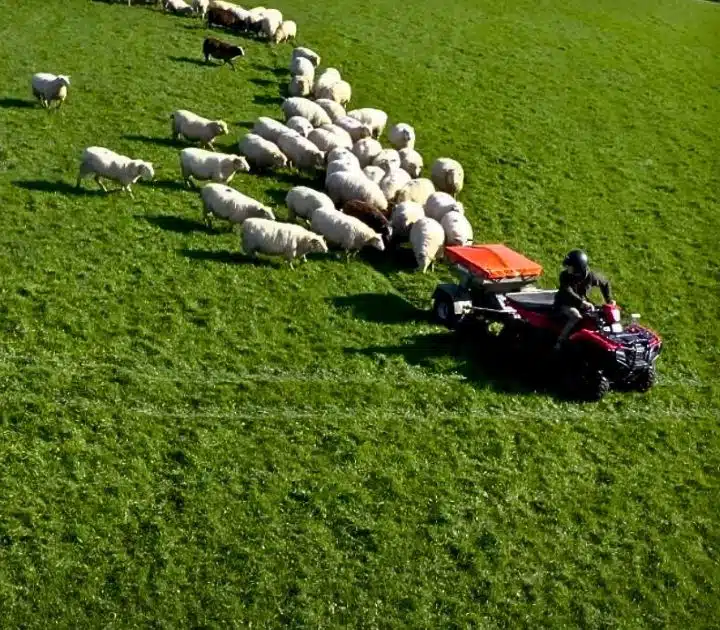
On most UK sheep farms, farmers repeat feeding routines daily — often before sunrise, through muddy paddocks, and with a quad bike weighed down by heavy feed bags. This essential work demands time and effort but rarely runs efficiently. For generations, farmers have relied on manual feeding, but many now discover a better alternative: the Sheep Snacker.
Farmers pull the Sheep Snacker — a trailed feeding system — behind an ATV, UTV, or tractor. It delivers precise portions of feed automatically as it moves across the land. This modern approach saves time, reduces labour, and improves feed consistency.
In this article, we explore Sheep Snacker vs manual feeding, using the Chapman TF350 as a prime example, to help you decide which system works best for your farm’s time, money, and animal welfare.
The Reality of Manual Feeding
Manual feeding involves unloading bags, spreading feed by hand or into stationary troughs, and often requires two people to manage the workload. Depending on flock size and terrain, this can take 60 to 90 minutes or more per feeding session.
Inconsistent portion sizes lead to feed waste and uneven nutrition. Animals often crowd feeding areas, increasing stress and competition, especially in larger groups.
Additionally, manual feeding becomes more challenging in bad weather or difficult terrain, increasing physical strain and risk of injury.
What Makes a Sheep Snacker a Game-Changer?
The Chapman TF350 Sheep Snacker offers a highly mobile, efficient alternative that can transform feeding operations. Here’s why:
- Efficiency: It delivers feed drops automatically every 2.4 seconds (about 25 drops per minute) as it’s towed, allowing one person to cover large areas quickly.
- Customizable Portions: Feed portions can be precisely set from 0.5kg to 2kg, improving feed management and reducing waste.
- Mobility: With 300mm ground clearance and flotation tyres, it handles rough terrain without damaging soil or slowing down.
- Durability: Built from galvanised steel with weather-resistant, IP67-rated electronics, it withstands harsh conditions.
- User-Friendly Controls: The electronic counter can be set to a specific number of feed drops and will automatically stop when finished, ensuring accuracy and saving operator effort.
- Reduced Animal Stress: Consistent, evenly spaced feeding reduces competition and crowding, promoting better animal welfare.
Sheep Snacker vs Manual Feeding: Comparing Time and Cost Savings
Consider a mid-sized flock of 250 to 300 sheep. Manual feeding could take around 90 minutes per session, often requiring multiple trips carrying heavy bags. Over a 90-day feeding period, that’s roughly 45 hours spent just on feeding.
With a Sheep Snacker, feeding time can drop to just 25 to 30 minutes per session with a single operator. That’s over 50% time saved — freeing you to focus on other critical farm tasks.
Moreover, precision feeding reduces waste, potentially saving money on feed costs. Over time, these savings often offset the initial investment in equipment.
Manual vs Sheep Snacker: Which Feeding Method is Best for Your Farm?
- Small Flocks or Limited Budget: Manual feeding might still be sufficient for small operations or those just starting out.
- Medium to Large Farms: The Sheep Snacker’s labour savings, feed precision, and animal welfare benefits make it the clear choice.
- Mixed Livestock: Its versatility extends to feeding cattle as well, adding further value for mixed farms.
Ready to Upgrade Your Livestock Feeding System?
If you want to streamline your feeding, reduce labour costs, and improve your animals’ health, the Sheep Snacker is a proven, practical solution. Built tough for UK farm conditions, the Chapman TF350 offers reliability, efficiency, and ease of use.
Explore the full specifications and options on our Sheep Snacker page or call us on 0333 880 6654 to speak with an expert today for pricing and more information.